Tag Archives: VMware

Automated VM provisioning

The use cases for PowerCLI and automation continue to amaze me, a couple of nice use cases I have seen recently involve automating the deployment of VM’s for various reasons.

The first reason, performance, what happens when a VM which is sat there for most of the year suddenly becomes busy and doesn’t have enough resources to satisfy whatever service it is trying to provide, do you add more ram, more CPU, what happens when you get to the maximum 8 CPU’s and the maximum vSphere VM memory of 255GB, do you then deploy a second VM and a third etc etc

Take this scenario into consideration:

You work in the UK for a county wide radio station, most of the time your virtualised cluster of web servers is sat there doing nothing, serving the odd hit now and again…but then it snows !

As we know, the UK can not handle snow at the best of times, the country grinds to a halt, the only means of knowing if your children’s school is closed is to check the local radio station’s website….enter our problem.

As you are also snowed in and unable to make it to the office you are unable to build the VM’s and add them to the cluster to allow the existing VMs which are now stuck on 100% CPU usage whilst you dig your car out.

Wouldn’t it be nice if we could have an automated response to this ? I held aloft my sword and said “With the power of CLI” (He-Man fans will get this).

I have two methods for this, the first one is a great script and the second is a bit of fun to show exactly how powerful PowerShell and PowerCLI can be. Continue reading →

PowerCLI: Changing a VM IP Address with Invoke-VMScript

One of the cmdlets that has been much improved in the recent version of PowerCLU 4 U1 is the Invoke-VMScript cmdlet,

This cmdlet runs a script or command inside the guest OS of each of the specified virtual machines. To run Invoke-VMScript, the user must have read access to the folder containing the virtual machine and a Virtual Machine.Interaction.Console Interaction privilege.

The virtual machines must be powered on and have PowerShell and VMware Tools installed.

Network connectivity to the ESX system hosting the virtual machine on port 902 must be present.

You must also have both the Host and guest credentials available.

One question asked of me recently was “Is there a way to set the IP address of some windows virtual machines with PowerCI ?”.

So with the power of the invoke-cmdlet in the following example you can see how you can change the ip address by using the netsh command inside the VM.

As a note, you no longer need PowerShell inside the guest OS for this cmdlet to work, as you can see below I am calling a batch command, you can also use this cmdlet against *nix machines to run shell commands.

This of course can easily be adjusted to read all ip addresses from a csv file or text file and apply them to multiple virtual machines if needed.

Continue reading →

Learn PowerCLI by video

So you want to learn PowerCLI, if your not a book kinda person and haven’t purchased Hal Rottenberg’s great book, Managing VMware Infrastructure with Windows PowerShell then there is great news for you.

Trainsignal have let it slip that coming soon to a website near you will be….

Managing VMware vSphere with PowerCLI – Hal Rottenberg

  • Video 1 Introduction to Power CLI
  • Video 2 PowerShell Basics
  • Video 3-1 PowerCLI Concepts – Part 1
  • Video 3-2 PowerCLI Concepts – Part 2
  • Video 4 Power CLI in the Real World
  • Video 5 PowerCLI Cmdlet Deep Dives

So you not only get to learn PowerCLI but you also get to see the man behind the book, the man behind the podcast and the man behind the MVP – Hal himself.

Continue reading →

PowerCLI: Working with events

Today a question was asked of me, someone asked how to find out who had deleted a ResourcePool, now im not one to get anyone into trouble but I also cant resist a scripting challenge so here was the process I used to write the following one-liner:

Get-VIEvent | Where { $_.Gettype().Name -eq "ResourcePoolDestroyedEvent"} | Select CreatedTime, UserName, FullFormattedMessage

Ok, so we know that everything we do in the vSphere client produces an event so there must have been an event record, in this record we know that the person is recorded as we can easily create a test resource pool and delete it, this will allow us to test the information we need:

image

Continue reading →

PowerCLI: Virtual Machine disk usage

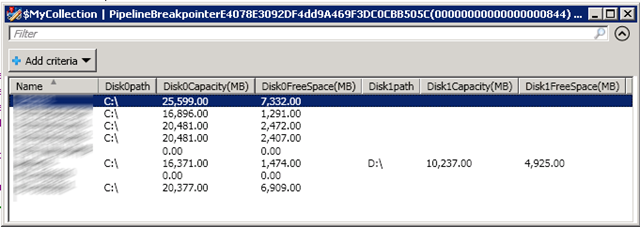
Recently I have had a few comments on an old post I wrote showing a one-liner to get the VM’s disk sizes for each VM, I was asked if there was a way to export this information into a CSV file.

The easy answer is yes but what you need to do is build up a container and then add each part of the information to the container, this is quite common practice in PowerShell, its a great technique where you can basically build and populate your own information and then just add to it, once you are completed you can then take your container and export it to whatever format you wish, for example:

The one-liner mentioned in my previous post simply outputted the data one VM at a time to the screen, whilst this was great for looking at the information, when we try and export it things start to go wrong !

The new script, below, may take up more lines but is far more efficient and adaptable.

image

Continue reading →

PowerCLI: Scripting ESXi

As the service console is moved further away from the hypervisor, people are finding it harder to configure ESX in the same way as has been done in previous versions.

Moving forward the only way to do this really is by accessing ESXi through the API using scripting toolkits such as PowerCLI or the Perl toolkit.

There are two basic versions of ESXi “free” and “licensed”, the scripting toolkits are limited to read-only access for the free version of VMware ESXi. When the host is upgraded to vSphere Essentials, vSphere Essential Plus, vSphere Standard, vSphere Advanced, vSphere Enterprise, or vSphere Enterprise Plus these toolkits have write-access enabled and provide a scriptable method for managing ESXi hosts. Continue reading →

ESX4 U1 & the Intel 82576 Gigabit Network Adapter

Previously when installing ESX it has picked up all devices and automatically installed everything needed to use the server as an ESX host, recently whilst installing a new Dell R710 (a great review of the server can be found on the techhead.co.uk site here) I came across an issue where the additional Network Adapter in the PCI slot was not found by ESX.

The R710 has 4 internal adapters which were found as below:

image

Continue reading →

PowerCLI: Automating traffic shaping on portgroups

I was contacted by someone who needed to automate some changes to their virtual infrastructure, I can never resist a challenge so of course I agreed to help.

He worked for a Virtual Hosting platform who offer hosting at a low cost of entry.  Each customer where he works is provided with a dedicated  virtual machine, a public IP space in a logical VLAN.   As such his platform is currently 9 hosts, 190 VM’s and 60 Portgroups/VLAN’s. The platform is based on HP c700 Chassis with Cisco 3020 gig switches, with each “half” of the chassis trunked back to our core with a 2Gbps etherchannel. Each Blade’s “production” interface is connected to each “half” of the chassis at 1Gbps with originating VM id based load balancing. Continue reading →

PowerCLI: Comparing Clusters

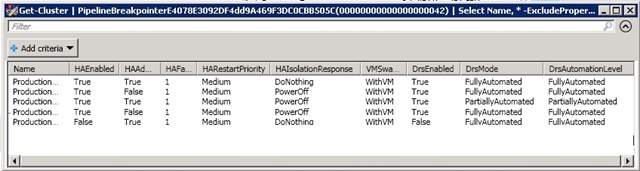
A simple one-liner for today, I needed to check all our current clusters and ensure all the ‘Production’ clusters were set the same, now we could go to each one and look at the settings but in this wonderful PowerCLI world we live why would you do anything more than once ?

The code is simple:

Get-Cluster | Select Name, * -ExcludeProperty id, CustomFields, ParentId | Sort Name | Out-GridView

The Get-Cluster cmdlet gets all the cluster information and then we simple exclude a few of the items I am not really interested in and then push the output through Out-GridView to display a nice filterable table as below:

Cluster

Continue reading →

vSphere Quick Start Guide – PowerCLI and PDF

In case you haven’t bought a copy of the “vSphere Quick Start Guide” yet and were thinking of buying one, there are a couple of things I would like to point out…

I was responsible for adding all the PowerCLI throughout the book, basically if something is explained and there is an easy way to do it in PowerCLI, we have added a code reference, this enables you to see how much is covered by PowerCLI and also how easy it actually is.

Continue reading →